
Skip to content
Gloucester County Amateur Radio Club

Gloucester County Amateur Radio Club

Skunkworks Advanced Project Team

Menu
  • Home
  • Current Activities
  • Clubhouse
    • The GCARC Clubhouse
    • Grounding Project
    • Networking Infrastructure
    • Work and Test Bench
    • Clubhouse Satellite Station
      • Satellite Rotator Controller
    • SatNOGS Ground Station
    • Earth-Moon-Earth (EME)
    • Discovery Satellite Snooping Dish
    • GOES-19 Satellite Reception
    • Clubhouse Remote nRSP-ST Resource
    • Skunkworks GitHub Resource
    • ISS SSTV
    • NOAA Weather Fax
    • ADS-B
  • Technical Resources
    • 3D Printed Projects
    • DMR
      • Recent DMR Activity
      • What is a DMR Codeplug?
        • What Are DMR Channels?
        • What Are DMR Timeslots?
        • What is a Talkgroup in DMR?
        • What Are DMR Zones?
      • What is a DMR Hotspot?
      • Configuring DMR Hotspot for GCARC Talk Group
      • Connecting to the GCARC DMR TalkGroup with a Yaesu System Fusion Radio and a Hotspot
      • Using DM-1701 CPS Program
      • Open GD77 on Baofeng DM1701
      • Pi-based OpenGD77 Flasher: Bypassing Windows Driver Headaches
    • Software-Defined Radios
      • Software Defined Radio Demystified
      • Installing an RTL-SDR on a Windows PC
      • SDR Tech Saturday Presentation January 2025
      • SDR Client Applications for Mac
      • Creating a PiAware Station to Track Airplanes
        • Installing PiAware Using the Prebuilt SD Card Image with Raspberry Pi Imager
        • Installing PiAware using Command Line Commands
    • Meshtastic
      • Getting Started with Meshtastic on 915 MHz
      • How to Join the GCARC Channel on Your Meshtastic Device Using a QR Code
      • Installing the Meshtastic CLI on a Windows PC
      • Window-Mounted 915 MHz Meshtastic Yagi Antenna Project
      • Meshtastic CLI Commands
    • Exploring Ham Radio Digital Modes: Packet Radio and WSJT-X
      • Packet Radio (AX.25) in Amateur Digital Communications
      • Exploring WSJT Digital Modes
    • BTECH UV-PRO Radio
      • Satellite Mode for the UV-PRO
    • TIDRADIO H3 Resources
      • TIDRADIO TD-H3 Transceiver: Comprehensive Briefing
      • Overview of Stock Firmware Menu System
      • Comparison of Stock TIDRADIO Firmware vs. nicFW V2 Firmware
    • Balloon Project
      • Balloon Launch – 2025-03-17
    • Tech Saturday Presentations
  • STEM Activities
  • Public Service
    • Winlink VHF and HF Gateways
    • APRS Weather Reporting Station
    • AREDN Development
  • The Foundation
  • Blog
  • Contact

Pi-based OpenGD77 Flasher: Bypassing Windows Driver Headaches

The biggest headache when flashing OpenGD77 firmware on DMR radios is the Windows USB driver situation. The STM32 DFU device that’s used to talk to many radios that are in DFU (firmware programming) mode relies on outdated, often unsigned drivers that Windows 11 routinely blocks via signature enforcement. Even when forced through, the process suffers from frequent timeouts, “device not found” errors, and compatibility crashes in the loader—turning what should be a quick flash into long, frustrating troubleshooting on every PC. At a club work session with multiple radios to upgrade, these issues waste time and kill momentum.
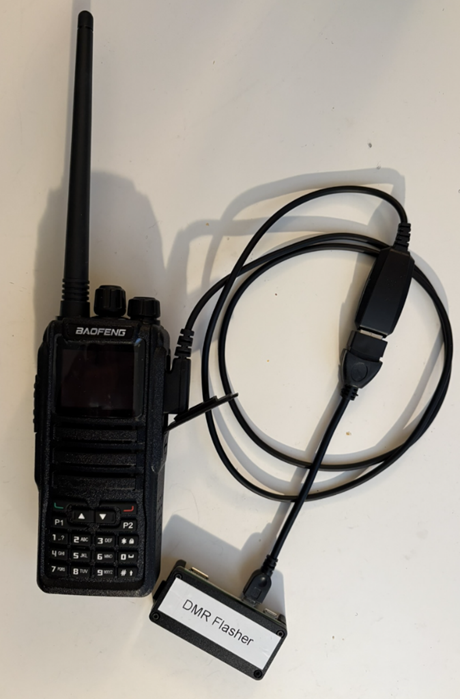
To solve this, we built a dedicated Raspberry Pi Zero W as a standalone, web-based flasher appliance. Linux handles raw USB DFU access natively through libusb—no drivers, no signature enforcement, no permission fights. The Pi boots, joins the clubhouse Wi-Fi and runs a minimal Flask server hosting a simple browser interface at http://dmr-flasher.local:5000 or an IP address assigned at the clubhouse. Any phone, tablet, or laptop on the network can access it without installing anything. Hook the radio’s programming cable up to the Pi, bring up the web interface,  select the radio type and driver and it will upload the new firmware to the radio for you.  (Thanks to Grok AI for the code, as usual…)
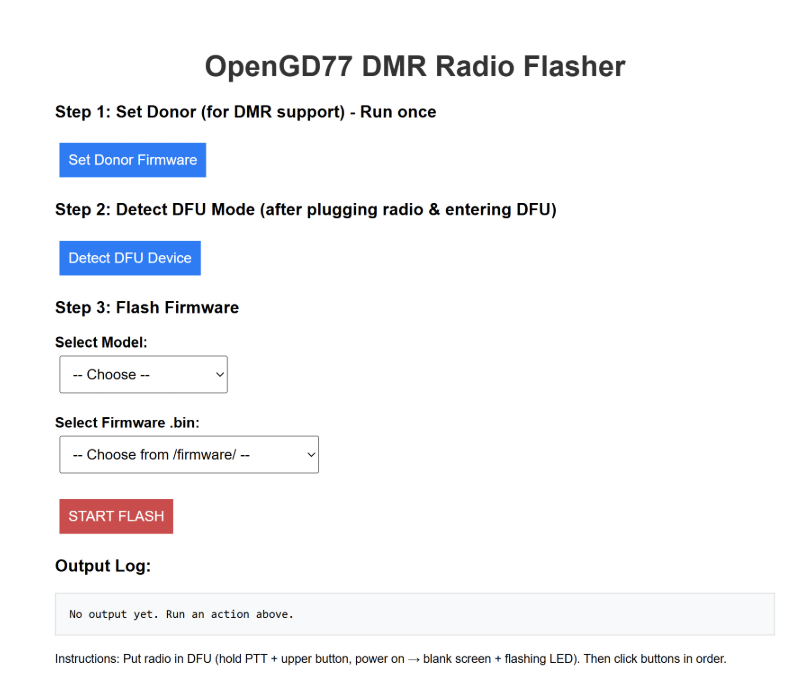
Usage is dead simple: power on the Pi, connect the radio via programming cable, enter DFU mode (PTT + upper side button while powering on until blank screen and flashing LED), open the web page, select the model (e.g., MD-UV380 for TYT variants), choose the .bin file, and click Start Flash. The interface displays real-time progress from the loader script, including donor patching and block writes. When finished, disconnect and reboot the radio into OpenGD77.

We’re going to leave the Pi at the clubhouse for anyone who wants to set up their DMR radio, and will use it for the rescheduled DMR review session that will happen some Saturday in March. So if you have a new radio that you want to get working in OpenGD77 don’t fool around with the Windows drivers, but instead come to the clubhouse and use this Pi to do the flashing. It will save a lot of time.  

Archives

  • July 2024
  • November 2023
  • April 2023
  • March 2023
  • June 2022
  • July 2021
  • April 2021
  • March 2021
  • September 2020
  • September 2019
  • August 2019
  • July 2019
  • June 2019
  • December 2018
  • November 2018
  • October 2018
  • September 2018
  • August 2018
  • July 2018
  • June 2018
  • May 2018
  • April 2018

Categories

  • Balloon
  • Clubhouse Infrastructure
  • Digital Position Tracking
  • Raspberry Pi
  • Satellite Images
  • Satellite Operations
  • Satellite Telemetry
  • SDR
  • Uncategorized

Meta

  • Log in
  • Entries feed
  • Comments feed
  • WordPress.org
  • Home
  • Current Activities
  • Clubhouse
    • The GCARC Clubhouse
    • Grounding Project
    • Networking Infrastructure
    • Work and Test Bench
    • Clubhouse Satellite Station
      • Satellite Rotator Controller
    • SatNOGS Ground Station
    • Earth-Moon-Earth (EME)
    • Discovery Satellite Snooping Dish
    • GOES-19 Satellite Reception
    • Clubhouse Remote nRSP-ST Resource
    • Skunkworks GitHub Resource
    • ISS SSTV
    • NOAA Weather Fax
    • ADS-B
  • Technical Resources
    • 3D Printed Projects
    • DMR
      • Recent DMR Activity
      • What is a DMR Codeplug?
        • What Are DMR Channels?
        • What Are DMR Timeslots?
        • What is a Talkgroup in DMR?
        • What Are DMR Zones?
      • What is a DMR Hotspot?
      • Configuring DMR Hotspot for GCARC Talk Group
      • Connecting to the GCARC DMR TalkGroup with a Yaesu System Fusion Radio and a Hotspot
      • Using DM-1701 CPS Program
      • Open GD77 on Baofeng DM1701
      • Pi-based OpenGD77 Flasher: Bypassing Windows Driver Headaches
    • Software-Defined Radios
      • Software Defined Radio Demystified
      • Installing an RTL-SDR on a Windows PC
      • SDR Tech Saturday Presentation January 2025
      • SDR Client Applications for Mac
      • Creating a PiAware Station to Track Airplanes
        • Installing PiAware Using the Prebuilt SD Card Image with Raspberry Pi Imager
        • Installing PiAware using Command Line Commands
    • Meshtastic
      • Getting Started with Meshtastic on 915 MHz
      • How to Join the GCARC Channel on Your Meshtastic Device Using a QR Code
      • Installing the Meshtastic CLI on a Windows PC
      • Window-Mounted 915 MHz Meshtastic Yagi Antenna Project
      • Meshtastic CLI Commands
    • Exploring Ham Radio Digital Modes: Packet Radio and WSJT-X
      • Packet Radio (AX.25) in Amateur Digital Communications
      • Exploring WSJT Digital Modes
    • BTECH UV-PRO Radio
      • Satellite Mode for the UV-PRO
    • TIDRADIO H3 Resources
      • TIDRADIO TD-H3 Transceiver: Comprehensive Briefing
      • Overview of Stock Firmware Menu System
      • Comparison of Stock TIDRADIO Firmware vs. nicFW V2 Firmware
    • Balloon Project
      • Balloon Launch – 2025-03-17
    • Tech Saturday Presentations
  • STEM Activities
  • Public Service
    • Winlink VHF and HF Gateways
    • APRS Weather Reporting Station
    • AREDN Development
  • The Foundation
  • Blog
  • Contact

Gloucester County Amateur Radio Club 2026 . Powered by WordPress