
Welcome to the GCARC’s exploration of practical ham radio digital communications! In our upcoming 2026 Tech Saturday sessions, we’ll demystify two key approaches—starting with packet radio for robust local networking and emergency messaging, then moving to the WSJT-X suite for unlocking weak-signal wonders like global DX or moonbounce. These resources highlight their real-world use cases, from APRS tracking to FT8 contests, and explain why their modulation, encoding, and error-handling strategies fit specific scenarios—so you can choose the right tool for your operating style.
Packet radio stands as a cornerstone of amateur digital communications, enabling hams to send data like text messages, files, or position reports over VHF/UHF frequencies without relying on the internet—think of it as radio-based email or texting for emergency ops or local nets. Built on the AX.25 protocol, it breaks data into short bursts called packets, using Audio Frequency Shift Keying (AFSK) modulation with tones at 1200 Hz and 2200 Hz for bits, NRZI encoding to maintain sync, and a simple CRC for error detection followed by retries in connected mode. This setup shines in practical scenarios like APRS for real-time tracking during events or Winlink gateways for sending reports from the field, where moderate signal strength and shared channels are the norm. Its redundancy comes from acknowledgments and automatic reconnects, making it reliable for everyday use without needing ultra-sensitive decoding.

WSJT-X, on the other hand, is a powerhouse suite designed for pushing the limits of weak-signal communication, crafted by Joe Taylor (K1JT) and team to facilitate contacts under tough conditions like moonbounce (EME) or meteor scatter. It packs modes like FT8 (fast 15-second cycles with MFSK modulation), JT65 (for VHF EME with deep error correction), and WSPR (for propagation testing with extreme sensitivity down to -31 dB SNR). These use structured, timed sequences with forward error correction and high redundancy—think layered encoding that reconstructs messages from fragments—tailored for global DX or VHF scatter where signals are whisper-thin. Practical perks include auto-sequencing for effortless QSOs and tools like Echo mode for measuring your own moon reflections, helping optimize rigs for those “impossible” paths.
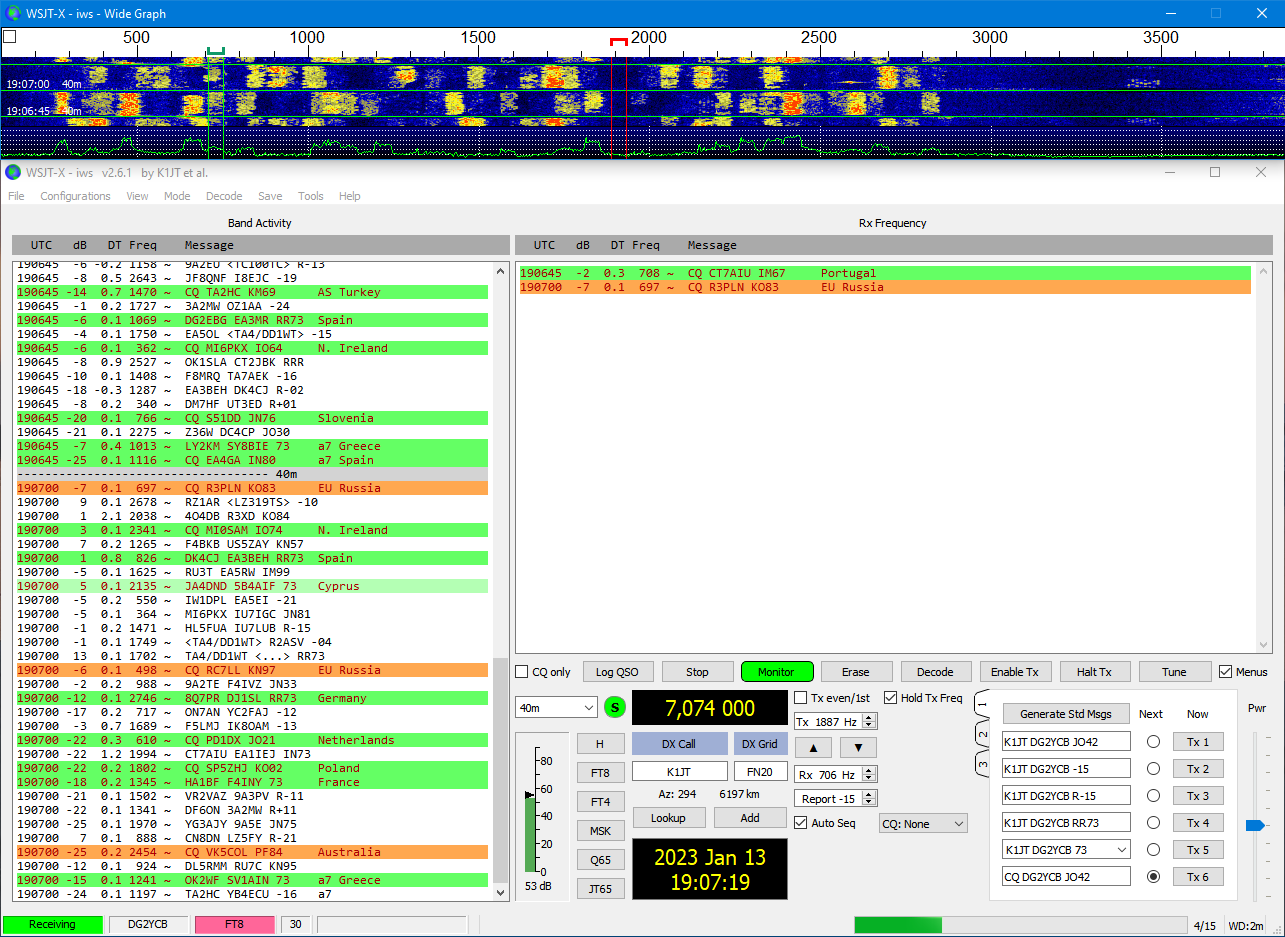
While both packet radio and WSJT-X open doors to digital ham adventures, they target different playgrounds: packet thrives in local, robust networks with its AFSK modulation and retry-based error handling, ideal for applications like Winlink email during outages or APRS for coordinating search-and-rescue, where signals are decent and speed with confirmation matters. WSJT-X, conversely, amps up the challenge with modes optimized for faint signals—using multi-tone shifts, heavy forward error correction, and timed redundancy to snag contacts across continents or off the moon, perfect for DX hunters or EME enthusiasts who battle noise floors that would sink packet. Their implementations reflect these goals: packet’s shared-channel design with CSMA collision avoidance suits crowded VHF nets, while WSJT-X’s structured frames and AP decoding push sensitivity limits for propagation modes like WSPR.
We’ll dive deeper into these in our 2026 Tech Saturday sessions at GCARC—first tackling packet radio to build hands-on skills for emergency comms and local data sharing, then shifting to WSJT-X to unlock weak-signal wizardry for chasing rare grids or testing propagation. Understanding their differences in modulation (packet’s simple tone shifts vs. WSJT-X’s complex multi-frequency keys), error strategies (retries for packet vs. built-in correction for WSJT-X), and redundancy levels equips you to pick the right tool—whether you’re linking a net during a storm or logging a transatlantic whisper on HF.