
Skip to content
Gloucester County Amateur Radio Club

Gloucester County Amateur Radio Club

Skunkworks Advanced Project Team

Menu
  • Home
  • Clubhouse
    • The GCARC Clubhouse
    • Grounding Project
    • Networking Infrastructure
    • Work and Test Bench
    • Clubhouse Satellite Station
      • Satellite Rotator Controller
    • SatNOGS Ground Station
    • Earth-Moon-Earth (EME)
    • Discovery Satellite Snooping Dish
    • GOES-19 Satellite Reception
    • Clubhouse Remote nRSP-ST Resource
    • Skunkworks GitHub Resource
    • ISS SSTV
    • NOAA Weather Fax
    • ADS-B
  • Technical Activities and Resources
    • 3D Printed Projects
    • DMR
      • Using DM-1701 CPS Program
      • Open GD77 on Baofeng DM1701
    • Software-Defined Radios
      • Installing an RTL-SDR on a Windows PC
      • Software Defined Radio Demystified
    • Meshtastic
      • Getting Started with Meshtastic on 915 MHz
      • How to Join the GCARC Channel on Your Meshtastic Device Using a QR Code
      • Window-Mounted 915 MHz Meshtastic Yagi Antenna Project
    • Exploring Ham Radio Digital Modes: Packet Radio and WSJT-X
      • Packet Radio (AX.25) in Amateur Digital Communications
      • Exploring WSJT Digital Modes
    • BTECH UV-PRO Radio
      • Satellite Mode for the UV-PRO
    • TIDRADIO H3 Resources
      • TIDRADIO TD-H3 Transceiver: Comprehensive Briefing
      • Overview of Stock Firmware Menu System
      • Comparison of Stock TIDRADIO Firmware vs. nicFW V2 Firmware
    • Balloon Project
      • Balloon Launch – 2025-03-17
    • Tech Saturday Presentations
  • STEM Club and Camp
  • Public Service
    • Winlink VHF and HF Gateways
    • APRS Weather Reporting Station
    • AREDN Development
  • The Foundation
  • Blog
  • Contact

Clubhouse Satellite Station: VHF/UHF Amateur Radio Satellite Communications

The GCARC clubhouse hosts a sophisticated satellite ground station designed for reliable communication with amateur radio satellites on VHF and UHF bands. The primary transceiver is the Icom IC-9700, a multi-band all-mode radio covering 144 MHz, 430 MHz, and 1200 MHz, used mainly for transmission due to its high power output and precise frequency control. Reception is handled by an SDRplay RSPdx software-defined radio receiver paired with SDR Console software, providing wideband spectrum visibility and excellent sensitivity for weak satellite signals. This dual-radio approach allows simultaneous transmit and receive operations with optimal performance on each path. The antennas are the M2 436CP42UG 42-element 70 cm antenna and the 2MCP22 22 element 2 meter antenna mounted on the M2 fiberglass crossboom.
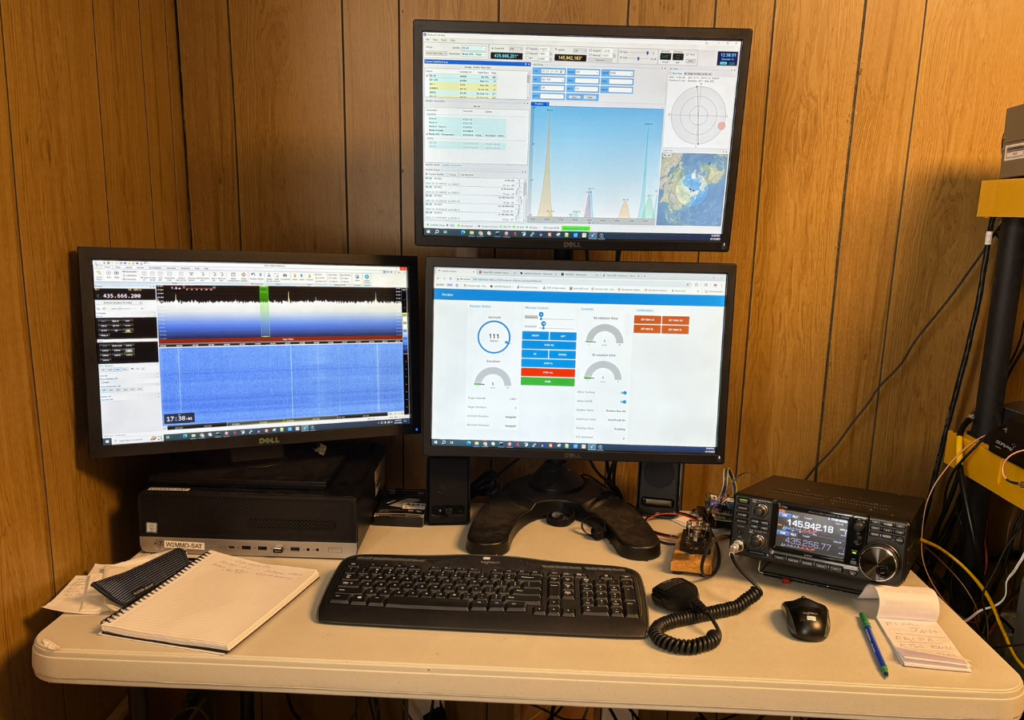
The entire station is automated using SkyRoof software, a specialized Windows application that integrates satellite tracking, pass prediction, frequency selection, and Doppler shift correction. SkyRoof calculates upcoming satellite passes, automatically tunes both the IC-9700 and SDRplay RSPdx to the correct uplink and downlink frequencies (compensating for Doppler effects caused by the satellite’s orbital motion), and points the antennas accordingly. Control of the radios is achieved through the Hamlib library’s rigctld daemon, which runs on the station’s Windows PC. Rigctld acts as a network server, listening on specific TCP ports and translating standard rigctl commands (a text-based protocol) into the native control commands for each radio—CI-V for the Icom IC-9700 and API calls for the SDRplay via SDR Console. This abstraction allows SkyRoof to control both radios uniformly without needing device-specific code.
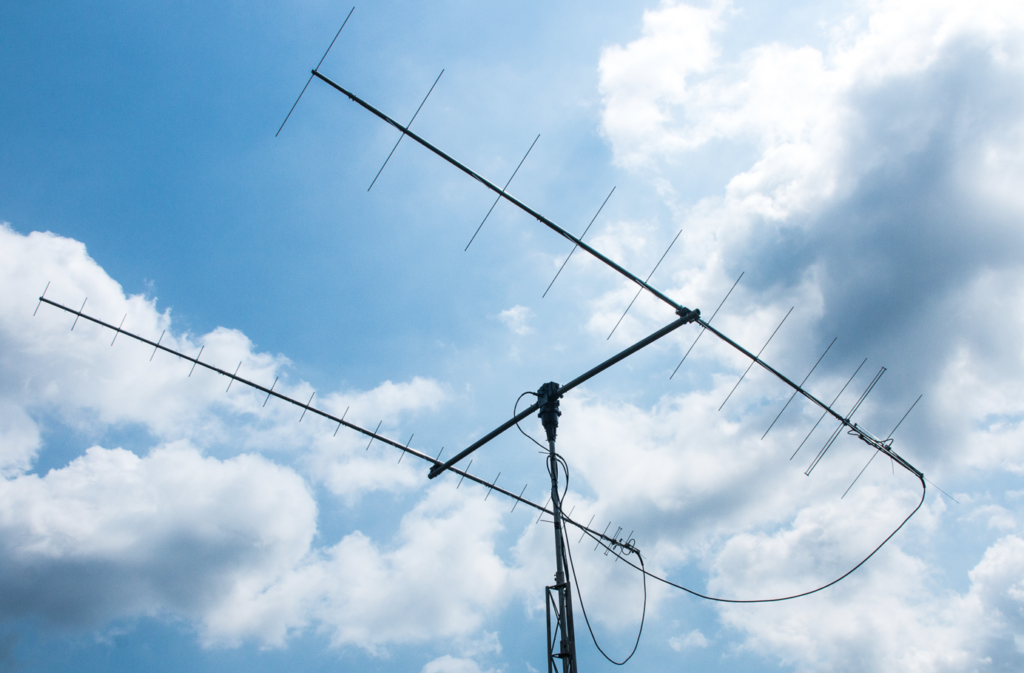
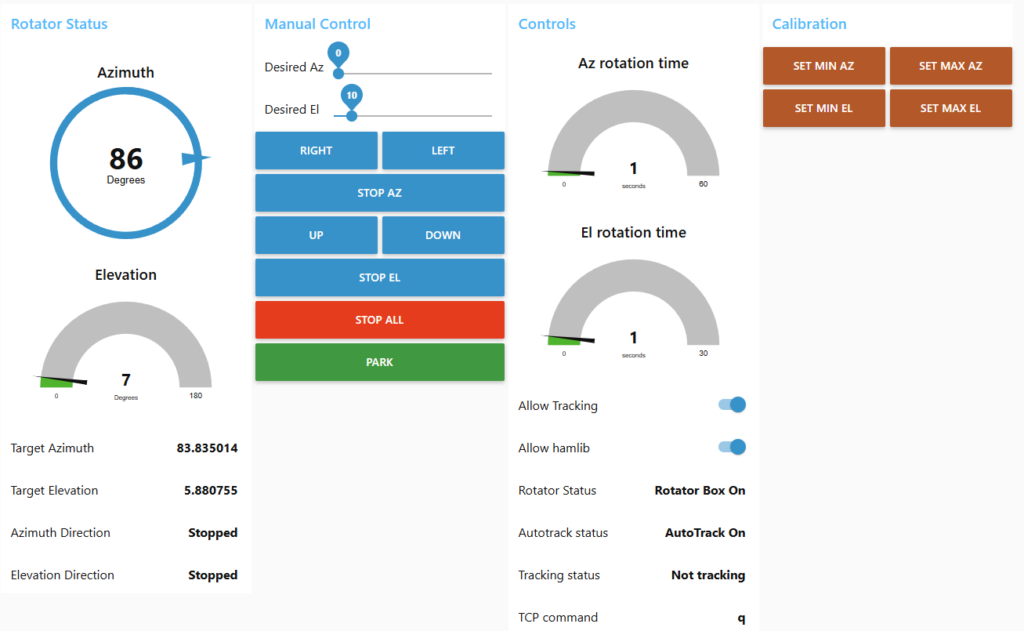
Antenna pointing is managed by a custom Node-RED program running on a Raspberry Pi Zero connected to the Yaesu G-5500 azimuth-elevation rotator controller. The Node-RED flow emulates the rotctld daemon protocol, listening for rotator control commands from SkyRoof and translating them into pulses for the G-5500 to adjust azimuth and elevation. This same Node-RED program is versatile, also used in SatNOGS ground stations for rotator control, and includes a built-in web interface for manual antenna adjustments via a browser.
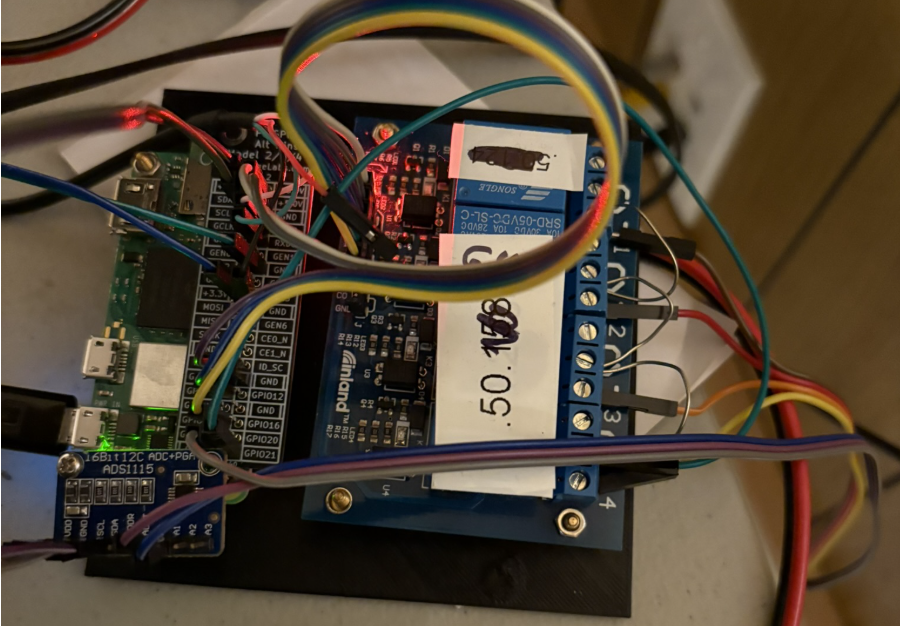
The Raspberry Pi Zero with the ADC and relay board controlling the antenna direction
The rotator controller dashboard

Antenna switching between transmit (IC-9700) and receive (SDRplay) paths is handled by a custom circuit board installed inside the IC-9700. This board detects transmit/receive states and provides a switched output to route the signal to the SDR receiver during reception, ensuring low-loss paths and protecting the sensitive SDR from high transmit power.

The station operates autonomously during satellite passes, enabling voice (SSB), digital modes, and telemetry reception. It supports linear transponder satellites (uplink on one band, downlink on another) with full Doppler correction and antenna tracking. Skyroof does a great job of allowing the user to navigate downlink frequencies on the SDR waterfall with the uplink frequency perfectly tracking the Doppler-correct corresponding uplink frequency, something that other programs like PST Rotator didn’t handle as well. The setup demonstrates advanced integration of commercial radios, SDR technology, open-source software (SkyRoof, Hamlib, Node-RED), and custom hardware, making reliable satellite contacts possible from the clubhouse location.

Archives

  • July 2024
  • November 2023
  • April 2023
  • March 2023
  • June 2022
  • July 2021
  • April 2021
  • March 2021
  • September 2020
  • September 2019
  • August 2019
  • July 2019
  • June 2019
  • December 2018
  • November 2018
  • October 2018
  • September 2018
  • August 2018
  • July 2018
  • June 2018
  • May 2018
  • April 2018

Categories

  • Balloon
  • Clubhouse Infrastructure
  • Digital Position Tracking
  • Raspberry Pi
  • Satellite Images
  • Satellite Operations
  • Satellite Telemetry
  • SDR
  • Uncategorized

Meta

  • Log in
  • Entries feed
  • Comments feed
  • WordPress.org
  • Home
  • Clubhouse
    • The GCARC Clubhouse
    • Grounding Project
    • Networking Infrastructure
    • Work and Test Bench
    • Clubhouse Satellite Station
      • Satellite Rotator Controller
    • SatNOGS Ground Station
    • Earth-Moon-Earth (EME)
    • Discovery Satellite Snooping Dish
    • GOES-19 Satellite Reception
    • Clubhouse Remote nRSP-ST Resource
    • Skunkworks GitHub Resource
    • ISS SSTV
    • NOAA Weather Fax
    • ADS-B
  • Technical Activities and Resources
    • 3D Printed Projects
    • DMR
      • Using DM-1701 CPS Program
      • Open GD77 on Baofeng DM1701
    • Software-Defined Radios
      • Installing an RTL-SDR on a Windows PC
      • Software Defined Radio Demystified
    • Meshtastic
      • Getting Started with Meshtastic on 915 MHz
      • How to Join the GCARC Channel on Your Meshtastic Device Using a QR Code
      • Window-Mounted 915 MHz Meshtastic Yagi Antenna Project
    • Exploring Ham Radio Digital Modes: Packet Radio and WSJT-X
      • Packet Radio (AX.25) in Amateur Digital Communications
      • Exploring WSJT Digital Modes
    • BTECH UV-PRO Radio
      • Satellite Mode for the UV-PRO
    • TIDRADIO H3 Resources
      • TIDRADIO TD-H3 Transceiver: Comprehensive Briefing
      • Overview of Stock Firmware Menu System
      • Comparison of Stock TIDRADIO Firmware vs. nicFW V2 Firmware
    • Balloon Project
      • Balloon Launch – 2025-03-17
    • Tech Saturday Presentations
  • STEM Club and Camp
  • Public Service
    • Winlink VHF and HF Gateways
    • APRS Weather Reporting Station
    • AREDN Development
  • The Foundation
  • Blog
  • Contact

Gloucester County Amateur Radio Club 2026 . Powered by WordPress