
The GCARC Skunkworks team has developed a window-mounted directional Yagi antenna optimized for Meshtastic nodes operating on the US frequency of 915 MHz. This project is inspired by a Hackaday article featuring a DIY Yagi antenna for LoRa signals, which demonstrated impressive range extensions at the European LoRa frequency of 868 MHz. Chris Prioli AD2CS took that basic design and completely redesigned it for the US 915 MHz band. Using YagiCAD for initial calculations and verifying with 4NEC2 simulations, he recalculated element lengths and spacings to achieve resonance at the correct frequency. He also created an entirely new 3D-printable boom design to accommodate the changed element positions.
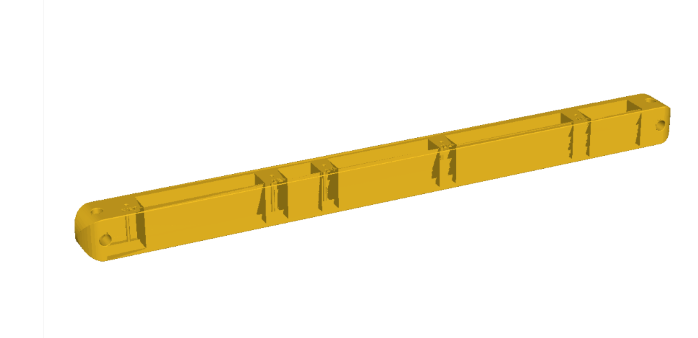
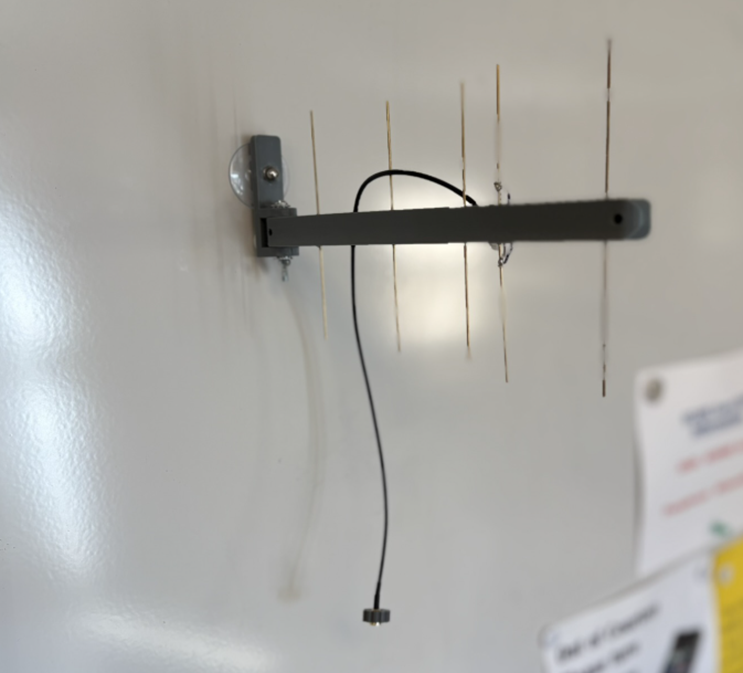
To mount the antenna securely on a window while pointing outward, Chris added connection points at each end of the boom for suction cups, allowing easy installation inside or outside the glass. This eliminates the common problem with stock Meshtastic antennas—many of which are poorly tuned and, when placed on a window sill, radiate half their power back into the room, severely limiting outdoor range. The directional Yagi focuses energy outward, dramatically increasing range in the desired direction while reducing indoor interference.
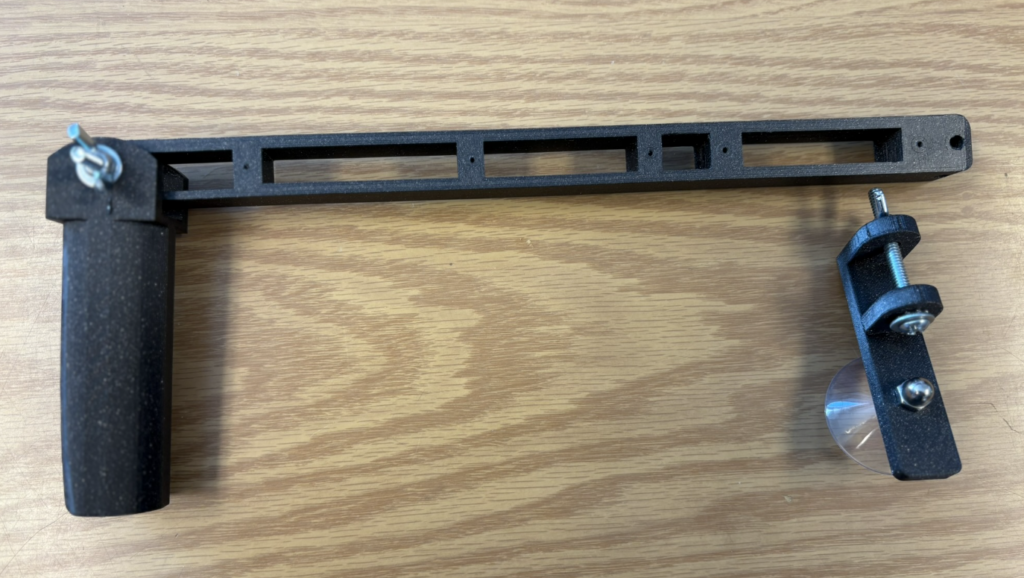
To retain the role of using the antenna for field testing Chris added a handle that can be installed in place of the window bracket.
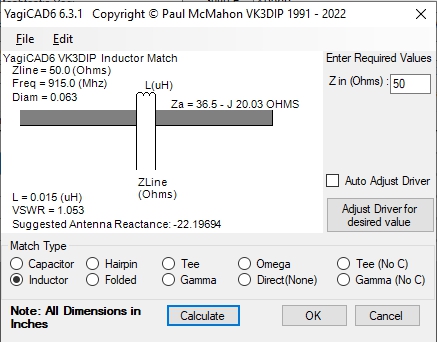
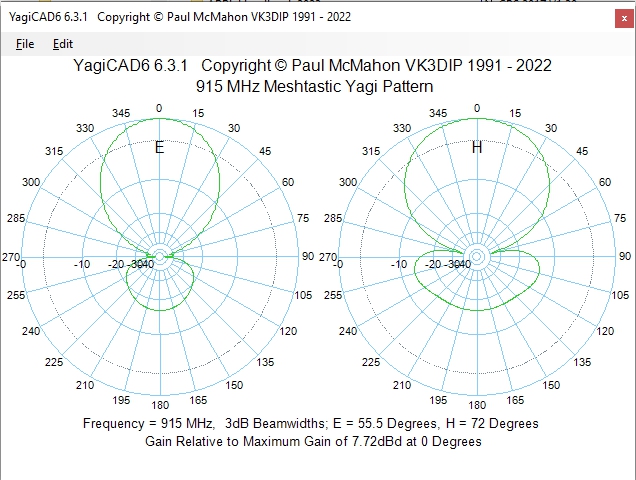
Initial modeling showed SWR values above 3:1, so Chris added an inductive match—a short coil of several turns of wire on the driven element—that brought the SWR down to approximately 1.8:1. Radiation pattern simulations in 4NEC2 indicated horizontal and vertical front-to-back gain of about 7.1 dB, a substantial improvement over typical stock omnidirectional antennas with 2-3 dB gain.
To share this design with club members, GCARC hosted antenna-building sessions at the GCARC Clubhouse. Initial estimates predicted 6-8 participants, but interest was overwhelming, with 24 sign-ups requiring a second session. Builders used 3D-printed booms, wire elements, and suction cups, assembling the antennas in a hands-on workshop. Early field reports have been outstanding: one user who previously received signals from only two nodes with a stock antenna now reliably hears nearly 200 nodes from his window-mounted Yagi, demonstrating the real-world performance boost.

Other groups are encouraged to build these antennas – the required files and instructions are on the GCARC GitHub site at https://github.com/w2mmdskunkworks/915MHzYagi.