
GCARC WSPR Propagation Report
⚡ Right Now — Which Bands Are Open?
August 04, 2026Live readout of where GCARC’s participating stations are hearing receivers right now (last 60 minutes). If you’re thinking about firing up the rig, this tells you what propagation looks like this minute. Updates every 5 minutes from wspr.wb2mnfai.org.
📶 Forty Meters — 40m
7 MHz · August 04, 2026The 40-meter band continues to deliver reliable mid-latitude propagation despite poor daytime conditions, with the nighttime Fair rating supporting consistent transatlantic and transpacific openings. K2ZA and N2LQH both logged best-distance contacts to Australia—VK5ARG at 10,551 miles and 10,568 miles respectively—demonstrating that 40m remains viable for genuine DX work even under these space weather constraints (SFI 126, K-index 4). The band shows bimodal activity peaks: a strong nocturnal window centered around 02:00 UTC favoring long-path skywave to Europe and the South Pacific, and a secondary diurnal peak near 11:00–12:00 UTC supporting regional groundwave and short-skip propagation. K2ZA achieved 374 unique receivers across 7,909 spots with a 706-mile average distance, suggesting robust regional coverage with occasional DX breaks. KC2GYU’s superior spot density of 14,654 detections indicates exceptional transmitter stability or receiver network timing advantage, reaching 372 unique stations and posting a best-distance mark of 10,606 miles to VK5EI. N2LQH’s 5-watt signal penetrated to 495 unique receivers with 188 European stations captured, establishing this station as the primary European gateway despite lower power-normalized efficiency. KE2AQZ performed credibly at 100 milliwatts, earning 4,802 spots and reaching EA8BFK at 3,514 miles—a notable accomplishment for low-power operation and evidence of favorable propagation geometry toward the Canary Islands during midday UTC hours.

📶 Thirty Meters — 30m
10 MHz · August 04, 2026Narrative not available.

📶 Twenty Meters — 20m
14 MHz · August 04, 2026The 20-meter band exhibited Fair propagation conditions throughout the reporting period, with the 14 MHz frequency sustaining reliable trans-Atlantic and trans-Pacific skip. The band demonstrated classic characteristics for its solar cycle phase, with K2ZA leading the pack by total spots at 5,488 and maintaining the highest unique receiver count at 461, while achieving genuine intercontinental reach including VK5EI at 10,588 miles. KC2GYU’s 7,563 total spots represent the highest activity level despite running just 200 milliwatts, pointing to aggressive operating schedules that capitalized on the Fair day and night conditions equally. Peak UTC hours clustered around the night boundary, with K2ZA and W2LJR showing 01:00 UTC peaks typical of European morning openings on 20m, while KC2GYU and W2MMD peaked at 12:00 UTC suggesting better daytime propagation to their respective targets. The European receiver count of 144 for K2ZA underscores 20m’s particular strength for stateside-to-Europe contacts, though N2LQH’s 207 EU receivers on 5 watts demonstrate that power and antenna efficiency matter equally. Notable DX included multiple VK-series contacts reflecting long-path or near-vertical incidence-angle propagation, with best distances ranging from 10,588 to 11,797 miles—consistent with a K-index of 4 and A-index of 19 providing modest but workable conditions.

📶 Fifteen Meters — 15m
21 MHz · August 04, 2026The fifteen-meter band continues to demonstrate reliable transequatorial and transatlantic propagation under Fair space weather conditions, with a solar flux index of 126 supporting consistent skip to both European and South Pacific regions. The four active stations collectively logged 6,029 spots across 152 to 279 unique receivers, establishing reliable paths to VK5ARG in Australia at distances exceeding 10,550 miles—a consistent achievement across all stations, suggesting well-established gray-line enhancement during the reporting period. Geographic coverage spans from domestic Northeast US reception through extensive European networks (6 to 137 receivers per station) and sporadic Pacific penetration, with peak activity clustering around 13:00 UTC for K2ZA and W2MMD, shifting to 15:00 UTC for the more efficient systems at KC2GYU and N2LQH. The K-index holding at 4 and A-index at 19 maintained stable ionospheric conditions without significant degradation, allowing sustained signal propagation particularly during daylight hours when F2 layer critical frequency remained favorable for 21 MHz skip. Average distances ranged from W2MMD’s modest 945 miles to N2LQH’s commanding 2,904 miles, reflecting both power deployment and antenna effectiveness, with KC2GYU’s 2,018-mile average from a quarter-watt input particularly noteworthy for efficiency.

📶 Ten Meters — 10m
28 MHz · August 04, 2026Narrative not available.

📡 WWV Reference — NIST Time Station
August 04, 2026WW0WWV is the NIST WWV/WWVH time-station beacon at Fort Collins, Colorado, transmitting WSPR continuously on multiple HF bands. Because its power, antenna and location are constant, it’s a steady benchmark for raw band openness — if WW0WWV is being heard widely on a band, that band is propagating. If it’s missing, the band is probably closed. P90 distance below is the same metric used in the per-band station tables on the live dashboard.
| Band | Spots (30d) | P90 (mi) | Best DX | First Heard (UTC) | Last Heard (UTC) |
|---|---|---|---|---|---|
| 40m | 2,026,168 | 1,557 | FR5DN | 2026/07/05 06:02 | 2026/08/04 05:58 |
| 30m | 1,911,956 | 1,643 | FR5DN | 2026/07/05 06:02 | 2026/08/04 05:58 |
| 20m | 2,000,971 | 1,643 | FR5DN | 2026/07/05 06:02 | 2026/08/04 06:00 |
| 15m | 669,328 | 1,603 | VK6XT | 2026/07/05 06:02 | 2026/08/04 05:56 |
| 10m | 355,687 | 1,094 | VK5HW | 2026/07/05 06:02 | 2026/08/04 05:58 |


P90 = 90th-percentile receiver distance — what you can reliably reach, ignoring the rare lucky DX. Best-DX callsign is the receiver that heard WW0WWV from the greatest distance over the last 30 days. Hourly charts cover the most recent 24-hour window.
☀️ Space Weather
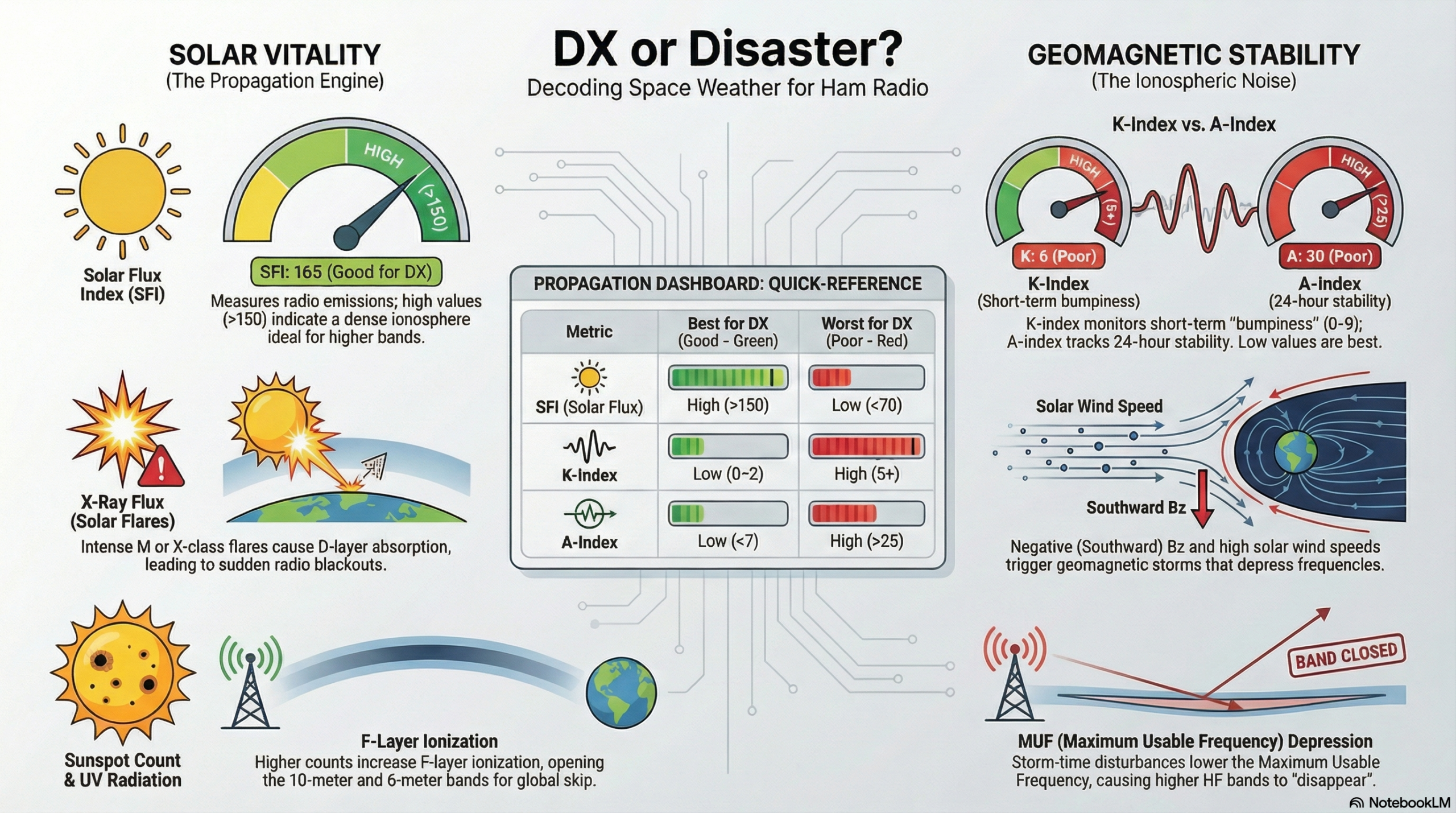
August 04, 2026Solar flux values of 126 are providing modest ionospheric support today, with the 104 sunspots contributing a moderate level of solar activity that should sustain reasonable F-layer density. This SFI reading is slightly above the historical average and is sufficient to keep the higher frequency bands open during daylight hours, particularly on 20 and 15 meters where fair conditions are forecast for both day and night periods. The 10-meter band, however, shows more variability with fair daytime propagation but poor conditions expected after sunset, suggesting that HF operators chasing DX should focus their 10-meter efforts during morning and afternoon windows rather than expecting extended evening openings. While these solar conditions won’t produce the spectacular skip distances or signal strengths associated with more active solar periods, they should provide consistent enough ionization for routine regional and moderate-distance communications across the upper HF bands.
The geomagnetic field is currently ACTIVE with a K-index of 4 and an A-index of 19, indicating moderate disturbance that will degrade propagation on the lower frequency bands and particularly impact long-distance paths toward the poles and across the Atlantic. A solar wind speed of 371.0 kilometers per second is elevated and contributing to this active geomagnetic state, which typically suppresses the D-layer absorption that affects 40 and 80 meters during daylight hours. The NOAA forecast showing poor daytime conditions on 80 and 40 meters reflects this solar wind influence, while the fair nighttime conditions on these same bands suggest that operators should expect brief windows of improved propagation after local sunset as the auroral oval activity patterns shift. Transatlantic and northern European paths will likely be significantly challenged today due to this moderate geomagnetic disturbance, making them poor choices for DX attempts unless operators are willing to accept reduced signal reports and difficult copy.
For today’s operations, the 30 and 20-meter bands represent the most reliable DX performers with fair conditions predicted around the clock, making them the primary focus for serious propagation work across both day and night. The 15-meter band also maintains fair daytime and nighttime conditions, offering another viable path for mid-range and some longer-distance contacts, though operators should be prepared for more variable results compared to 20 meters. Avoid the lower bands during daylight hours and save 80 and 40-meter efforts for after sunset when conditions transition to fair, and be aware that the currently active geomagnetic conditions mean that even nighttime lower-band propagation may deliver weaker signals than typical for the solar flux level. The elevated solar wind and moderate geomagnetic disturbance suggest that this is a day to focus on middle-HF band work rather than pursuing aggressive low-band or polar-path DX.
| Band | Daytime | Nighttime |
|---|---|---|
| 80 / 40m | Poor | Fair |
| 30 / 20m | Fair | Fair |
| 17 / 15m | Fair | Fair |
| 12 / 10m | Fair | Poor |
 Save as PDF