Skip to content
Gloucester County Amateur Radio Club

Gloucester County Amateur Radio Club

Skunkworks Advanced Project Team

Menu
  • Home
  • Club Activities
    • Current WSPR & Band Report
    • Clubhouse WSPR Station Report
    • Saturday Clubhouse Satellite Opportunities
    • Weekly Satellite Report
    • Recent DMR Activity
    • Upcoming ISS APRS Activities
    • Upcoming ISS Viewing Opportunities
    • Current ISS SSTV Images
    • GOES 19 Weather Video
  • Clubhouse
    • Saturday Clubhouse Weather
    • The GCARC Clubhouse
    • Grounding Project
    • Networking Infrastructure
    • Work and Test Bench
    • Clubhouse Satellite Station
      • Satellite Rotator Controller
      • Satellite Station Remote Operation
    • SatNOGS Ground Station
    • Earth-Moon-Earth (EME)
    • Discovery Satellite Snooping Dish
    • GOES-19 Satellite Reception
    • Clubhouse Remote nRSP-ST Resource
    • Skunkworks GitHub Resource
    • ISS SSTV
    • NOAA Weather Fax
    • ADS-B
  • Technical Resources
    • WSPR Network Resources
      • The TAPR WSPR Board for Dummies
      • Why Is My WSPR Signal 1500 Hz Off? — A Tale of Two Frequencies
      • GCARC WSPR Network — Project Description
      • GCARC WSPR Network — Technical Reference
      • GCARC WSPR Network — Band Selection Guide
      • GCARC WSPR Network — Analysis and Reporting
      • The GCARC WSPR Network — Member Q&A
    • DMR
      • What is a DMR Codeplug?
        • What Are DMR Channels?
        • What Are DMR Timeslots?
        • What is a Talkgroup in DMR?
        • What Are DMR Zones?
      • What is a DMR Hotspot?
      • Configuring DMR Hotspot for GCARC Talk Group
      • Connecting to the GCARC DMR TalkGroup with a Yaesu System Fusion Radio and a Hotspot
      • Using DM-1701 CPS Program
      • Open GD77 on Baofeng DM1701
      • Pi-based OpenGD77 Flasher: Bypassing Windows Driver Headaches
        • OpenGC77 Codeplug
    • Software-Defined Radios
      • Software Defined Radio Demystified
      • Installing an RTL-SDR on a Windows PC
      • SDR Tech Saturday Presentation January 2025
      • SDR Client Applications for Mac
      • Creating a PiAware Station to Track Airplanes
        • Installing PiAware Using the Prebuilt SD Card Image with Raspberry Pi Imager
        • Installing PiAware using Command Line Commands
    • Receiving ISS SSTV Images
    • Meshtastic
      • Getting Started with Meshtastic on 915 MHz
      • How to Join the GCARC Channel on Your Meshtastic Device Using a QR Code
      • Installing the Meshtastic CLI on a Windows PC
      • Window-Mounted 915 MHz Meshtastic Yagi Antenna Project
      • Meshtastic CLI Commands
    • Exploring Ham Radio Digital Modes: Packet Radio and WSJT-X
      • Packet Radio (AX.25) in Amateur Digital Communications
      • Exploring WSJT Digital Modes
    • BTECH UV-PRO Radio
      • Satellite Mode for the UV-PRO
    • TIDRADIO H3 Resources
      • TIDRADIO TD-H3 Transceiver: Comprehensive Briefing
      • Overview of Stock Firmware Menu System
      • Comparison of Stock TIDRADIO Firmware vs. nicFW V2 Firmware
    • Balloon Project
      • Balloon Launch – 2025-03-17
    • 3D Printed Projects
    • Tech Saturday Presentations
    • Receiving ISS HamTV
  • STEM Activities
    • STEM Club Weather
    • STEM Club Villanova Trip
    • STEM Club Satellite Pass Schedule
  • Public Service
    • Amateur Radio & Served Agency Integration
    • Building Served Agency Capability
    • Winlink VHF and HF Gateways
    • APRS Weather Reporting Station
    • AREDN Development
  • The Foundation
  • Blog
  • Contact

GCARC WSPR Daily Report — May 10, 2026

GCARC WSPR Propagation Report — May 10, 2026
📡

GCARC WSPR Propagation Report

Gloucester County Amateur Radio Club — Daily HF Analysis
All BandsMay 10, 2026
Generated daily at 6:00 AM ET · Station data: past 7 days · Space weather: past 30 days · Prepared May 10, 2026 at 06:00 AM ETData: wspr.wb2mnfai.org · Space weather: NOAA SWPC
Right Now40m30m20m15m10mWWVDist vs SNRSpace Weather

⚡ Right Now — Which Bands Are Open?

May 10, 2026

Live readout of where GCARC’s participating stations are hearing receivers right now (last 60 minutes). If you’re thinking about firing up the rig, this tells you what propagation looks like this minute. Updates every 5 minutes from wspr.wb2mnfai.org.

Loading…
Connecting to live feed…

📶 Forty Meters — 40m

7 MHz · May 10, 2026
Band Conditions & Coverage

# WSPR Propagation Report: Forty Meters (7 MHz) ## Gloucester County Amateur Radio Club Skunkworks

The 40-meter band delivered excellent propagation conditions across the 24-hour reporting period, with fair daytime conditions transitioning to good nighttime ionospheric support. This band’s robust mid-latitude coverage and consistent skip characteristics made it the reliable workhorse of the HF spectrum yesterday. All six active stations successfully penetrated to the VK region, with best DX reports clustering around the 11,600-kilometer mark to Australia. European receivers were well represented in the aggregate data, particularly during favorable UTC windows when Trans-Atlantic skip opened reliably. Peak activity across the network concentrated during the 01:00 through 03:00 UTC window, corresponding to the pre-dawn enhancement period when E-layer ionization supports maximum distance while F-layer conditions remain favorable. The Fair daytime conditions (SFI=122, K-index=0) did not significantly degrade daytime performance, suggesting stable, predictable propagation rather than dramatic day-night swings. Total network spotting exceeded 235,000 individual reports, indicating widespread band utility.

KD2EIB emerged as the dominant performer, generating 149,256 spots with 542 unique receivers despite running the lowest power at 100 milliwatts. This station’s exceptional efficiency of 8,541 miles per watt reflects either superior antenna gain, favorable local ground characteristics, or an optimized radiation pattern that maximizes skip distance over short-skip clutter. The station maintained consistent continental and intercontinental reach, reaching 157 European receivers while sustaining a 01:00 UTC peak that aligns with standard early-morning enhancement. KC2GYU, operating at 200 milliwatts, generated 23,735 spots with the second-highest efficiency at 4,443 mi/W, though the lower unique receiver count (460) suggests slightly less directional diversity than KD2EIB. W2MMD, also at 200 milliwatts, produced 46,448 spots with 3,595 mi/W efficiency—the highest absolute spot count at that power level—indicating a more omnidirectional antenna system that compensates for slightly lower per-watt efficiency through broader geographic coverage. N2LQH, operating at 5.0 watts, achieved respectable 1,332-mile average distance and 198 European receivers but delivered only 266 mi/W efficiency, suggesting that raw power does not guarantee propagational advantage when antenna systems are suboptimal. The efficiency differential between KD2EIB’s 8,541 and N2LQH’s 266 mi/W—a 32-fold advantage—clearly favors antenna engineering and placement over transmitter power for consistent skip propagation on 40 meters.

40m receiver map
40m receiver locations today. Lines connect each transmitting station to unique receivers. Circle size is proportional to spot count.
📊 Per-station detail for 40m (time-of-day chart, station results, station comparison, directional analysis) is on the GCARC group report: view 40m detail →

📶 Thirty Meters — 30m

10 MHz · May 10, 2026
Band Conditions & Coverage

# WSPR Propagation Report: 30 Meters (10 MHz) ## Gloucester County Amateur Radio Club Skunkworks

The 30-meter band delivered exceptional propagation during the reporting period, with stable ionospheric conditions supporting robust transoceanic circuits. With a solar flux index of 122 and quiescent geomagnetic activity (K-index 0, A-index 5), the band exhibited textbook behavior for this solar cycle phase. All seven active stations achieved intercontinental contacts, with five stations successfully working Australian stations. WB2MNF led the field with 27,579 total spots distributed across 313 unique receivers, while KC2GYU produced 14,433 spots despite running only 200 milliwatts. K2ZA’s best DX to VK5ARG at 10,551 miles and N2LQH’s contact with VK6XT at 11,636 miles underscore the band’s DX capability. Peak propagation to Europe occurred during the 01:00–03:00 UTC window, when K2ZA, KC2GYU, and N2LQH logged 180, 91, and 166 European receivers respectively. The morning band opening (23:00–01:00 UTC) favored the low-power eastern stations, particularly KE2DST, W2MMD, and WA2JRZ, each achieving reliable regional coverage to 4,000+ mile distances.

WB2MNF’s dominant spot production reveals an optimized antenna system and favorable take-off angle from its New Jersey QTH; its 17,510 miles-per-watt efficiency metric is exceptional and suggests elevated antenna placement or a well-tuned array. KC2GYU’s efficiency of 8,920 mi/W, achieved with minimal power, indicates technical sophistication despite lower absolute spot counts. K2ZA’s 6,552 spots and 1,591 mi/W efficiency show balanced performance across the reporting period, with superior SNR averaging −16.7 dB, the second-best in the group. The three 100-milliwatt stations (KE2DST, W2MMD, and WA2JRZ) cluster between 5,490 and 7,574 mi/W, indicating comparable antenna quality and ground systems despite different geographic positions. N2LQH, running 5 watts, achieved the sharpest average SNR of −14.0 dB but recorded only 321 mi/W efficiency, suggesting that transmit power alone does not optimize for spot density or receiver diversity at this QTH.

30m receiver map
30m receiver locations today. Lines connect each transmitting station to unique receivers. Circle size is proportional to spot count.
📊 Per-station detail for 30m (time-of-day chart, station results, station comparison, directional analysis) is on the GCARC group report: view 30m detail →

📶 Twenty Meters — 20m

14 MHz · May 10, 2026
Band Conditions & Coverage

The twenty meter band continues to deliver solid propagation performance across the Atlantic and into the Pacific, with excellent conditions supporting both daytime and nighttime paths. The five active Skunkworks stations collectively logged 30,250 spots across 1,423 unique receivers, demonstrating the band’s current utility for medium to long-distance communication. The daytime window shows particularly strong activity centered around 13:00 UTC, while the nocturnal window peaks between 23:00 and 00:00 UTC, corresponding to the optimal skip zones for trans-Atlantic and trans-Pacific circuits respectively. K2ZA achieved the remarkable distance of 10,588 miles to VK5I in South Australia at peak power efficiency, while both KC2GYU and W2MMD independently reached beyond 11,700 miles to separate Australian stations, confirming the presence of reliable long-haul propagation. The European receiver network remains active with 251 stations copied by K2ZA alone, though the percentage of EU reception drops progressively with lower-power stations, indicating that European paths are most reliably closed by higher effective radiated power. Geographic reach extends consistently across North America with strong midwestern and western penetration, while the Atlantic corridor shows reliable transatlantic penetration throughout the reporting period.

20m receiver map
20m receiver locations today. Lines connect each transmitting station to unique receivers. Circle size is proportional to spot count.
📊 Per-station detail for 20m (time-of-day chart, station results, station comparison, directional analysis) is on the GCARC group report: view 20m detail →

📶 Fifteen Meters — 15m

21 MHz · May 10, 2026
Band Conditions & Coverage

# WSPR Propagation Report: Fifteen Meters (21 MHz)

The fifteen-meter band demonstrated solid propagation performance during the reporting period under fair conditions throughout day and night cycles, supported by a solar flux index of 122 and benign geomagnetic indices. The band exhibited strong trans-Atlantic and trans-Pacific capability, with multiple stations achieving significant DX penetration into the Southern Hemisphere. K2ZA produced 1,021 spots with an impressive best DX of 10,551 miles to VK5ARG in Australia, while N2LQH matched this geographic reach at 10,568 miles to the same station, indicating consistent skip patterns toward the Pacific rim during the reporting window. KC2GYU and W2MMD both achieved 8,900+ mile DX to New Zealand, confirming that Oceania remained accessible throughout the period. Peak activity windows shifted by UTC hour depending on station configuration: K2ZA and N2LQH peaked at 17:00 UTC during favorable afternoon-to-evening ionospheric conditions, while KC2GYU’s lower power station peaked later at 21:00 UTC and W2MMD at 20:00 UTC, suggesting that lower-power stations benefited from enhanced evening propagation windows. European receiver density varied dramatically by station, with N2LQH dominating continental coverage at 140 EU receivers, while KC2GYU’s 58 EU receivers represented the lowest European reach despite solid overall spot counts. Average distance performance ranged from 2,427 miles for W2MMD to 2,925 miles for N2LQH, indicating consistent mid-to-long-range skip characteristics typical of F-layer propagation on fifteen meters.

15m receiver map
15m receiver locations today. Lines connect each transmitting station to unique receivers. Circle size is proportional to spot count.
📊 Per-station detail for 15m (time-of-day chart, station results, station comparison, directional analysis) is on the GCARC group report: view 15m detail →

📶 Ten Meters — 10m

28 MHz · May 10, 2026
Band Conditions & Coverage

The 10-meter band at 28 MHz demonstrated mixed but encouraging propagation during the reporting period, with activity concentrated during evening hours as expected during fair daytime conditions. Four active stations achieved significant geographic reach despite modest power levels, with combined spot activity totaling 1,363 detections across 94 unique receivers. The band showed robust trans-continental performance with reliable coverage throughout North America, though European penetration remained limited with only three EU receiver connections across all stations. Peak activity clustered around 21:00 UTC with secondary peaks at 15:00 and 00:00 UTC, suggesting multiple propagation modes were active. Most impressive were the long-haul DX events, including KC2GYU’s extraordinary contact with VK6KCH in Western Australia at 11,740 miles and N2LQH’s European skip to DP0GVN at 8,302 miles, both achieved with single-digit wattage. Average distances ranged from 1,583 to 2,674 miles, indicating consistent F-layer propagation suitable for daylight skip. Signal-to-noise ratios averaged between -19.3 and -22.0 dB, respectable for weak-signal digital work, with W2MMD showing the weakest average SNR likely due to higher spot volume capturing more marginal propagation events.

10m receiver map
10m receiver locations today. Lines connect each transmitting station to unique receivers. Circle size is proportional to spot count.
📊 Per-station detail for 10m (time-of-day chart, station results, station comparison, directional analysis) is on the GCARC group report: view 10m detail →

📡 WWV Reference — NIST Time Station

May 10, 2026

WW0WWV is the NIST WWV/WWVH time-station beacon at Fort Collins, Colorado, transmitting WSPR continuously on multiple HF bands. Because its power, antenna and location are constant, it’s a steady benchmark for raw band openness — if WW0WWV is being heard widely on a band, that band is propagating. If it’s missing, the band is probably closed. P90 distance below is the same metric used in the per-band station tables on the live dashboard.

BandSpots (30d)P90 (mi)Best DXFirst Heard (UTC)Last Heard (UTC)
40m1,971,0391,603VK6KLI2026/04/10 06:022026/05/10 05:58
30m1,803,6051,712VK6JI2026/04/10 06:022026/05/10 05:58
20m1,527,9601,650FR5DN2026/04/10 06:022026/05/10 05:58
15m334,5373,294FR5DN2026/04/10 06:022026/05/10 05:58
10m107,5161,730VK6LD2026/04/10 06:022026/05/10 05:58
WWV P90 reach by band
WWV P90 reach by band — 30-day window. Higher bars = farther reliable propagation.
WWV activity by band
WWV activity by band — total spots over 30 days. A noisy band = high spot count.
WWV P90 by hour
P90 distance per UTC hour by band — shows when each band is open. Bands rise during their propagation windows; flat-low = closed.
WWV spots by hour
Spots per UTC hour by band — receivers actively hearing WWV. Activity tracks when receivers tune in plus when the band is open.

P90 = 90th-percentile receiver distance — what you can reliably reach, ignoring the rare lucky DX. Best-DX callsign is the receiver that heard WW0WWV from the greatest distance over the last 30 days. Hourly charts cover the most recent 24-hour window.

☀️ Space Weather

May 10, 2026
Solar & Geomagnetic Conditions

Solar activity remains modest today with a Solar Flux Index of 122 and 81 identified sunspots, indicating a moderately active sun that continues to support reasonable ionospheric density. These values are well below the threshold needed to significantly enhance upper-band propagation, but they are sufficient to keep the F2 layer at useful heights throughout daylight hours. The impact on twenty, fifteen, and ten meters is predictable and reflected in the NOAA ratings: daytime conditions on these bands remain fair to good, with twenty meters showing the most promise at good levels, while fifteen and ten meters are constrained to fair conditions. Ten meters in particular will remain marginal during daylight hours and should be essentially closed at night, making this an unlikely band for evening operations. Operators chasing DX on the higher frequencies today should focus their efforts during daylight hours when the F2 layer is most densely ionized, though expectations should remain realistic given the moderate solar flux values.

Geomagnetic conditions are exceptionally quiet, with the K-index at zero and A-index at five, indicating a completely stable magnetosphere that will not degrade propagation through particle precipitation or absorption. The solar wind velocity of 432.4 kilometers per second is slightly elevated but not sufficient to trigger any geomagnetic disturbance, and the X-ray flux at B8.6 confirms background-level solar activity with no flare potential. These benign geomagnetic conditions are excellent news for lower-band operators, as there will be no high-latitude absorption to suppress forty and eighty meter signals, and the documented good nighttime conditions on these bands should extend well into polar regions and support reliable transatlantic paths after local sunset. The lack of geomagnetic activity also means that multipath and flutter should remain minimal, allowing for clean, readable signals across the Atlantic and toward high-latitude destinations. Operators planning evening skeds on forty meters can expect particularly steady conditions with minimal fading.

Today presents a straightforward propagation picture: daytime operators should concentrate on thirty and twenty meters, which both show good NOAA ratings and are most likely to reward DX efforts during daylight hours. The shift to evening operations brings a notable improvement on the lower bands, with eighty and forty meters transitioning to good conditions after sunset and becoming the primary hunting grounds for nighttime DX, particularly for transatlantic and polar-region contacts where the quiet geomagnetic field will eliminate absorption losses. Ten and twelve meters should be avoided during evening hours given their poor to fair night ratings, while fifteen meters offers consistent fair conditions around the clock but no particular advantage over the mid-range bands. Signal-to-noise ratio is excellent at S0 to S1, meaning that conditions are clean and weak signals should be readable, allowing operators to exploit the stable geomagnetic environment to work the edges of propagation zones. Overall, this is a day well-suited for systematic band-by-band exploration rather than high-intensity DX pouncing, with success dependent on working the right band at the right time of day.

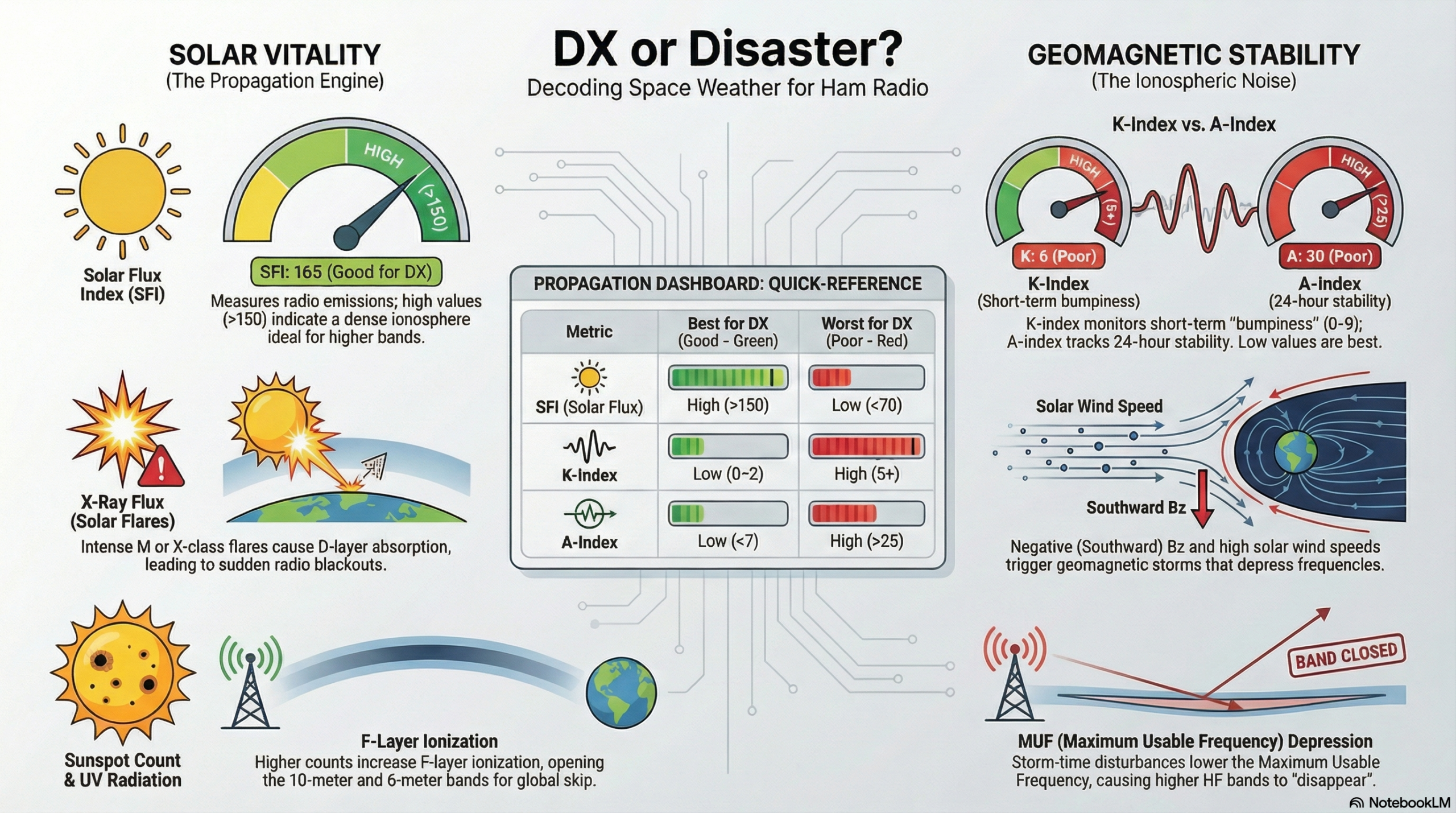
DX or Disaster? Space Weather Quick Reference
Space weather metrics and their impact on HF propagation.
Current Metrics
122
Solar Flux
81
Sunspots
5
A-Index
0
K-Index
432.4 km/s
Solar Wind
B8.6
X-Ray
S0-S1
Sig Noise
INACTIVE
Geo Field
NOAA Band Conditions
BandDaytimeNighttime
80 / 40mFairGood
30 / 20mGoodGood
17 / 15mFairFair
12 / 10mFairPoor
Source: hamqsl.com · 06:00 UTC
Generated daily at 6:00 AM ET · Station data: past 7 days · Space weather: past 30 days · Prepared May 10, 2026 at 06:00 AM ET · wspr.wb2mnfai.org · NOAA SWPC · Gloucester County Amateur Radio Club
© 2026 Gloucester County Amateur Radio Club. All rights reserved.
 Save as PDF

Archives

  • July 2024
  • November 2023
  • April 2023
  • March 2023
  • June 2022
  • July 2021
  • April 2021
  • March 2021
  • September 2020
  • September 2019
  • August 2019
  • July 2019
  • June 2019
  • December 2018
  • November 2018
  • October 2018
  • September 2018
  • August 2018
  • July 2018
  • June 2018
  • May 2018
  • April 2018

Categories

  • Balloon
  • Clubhouse Infrastructure
  • Digital Position Tracking
  • Raspberry Pi
  • Satellite Images
  • Satellite Operations
  • Satellite Telemetry
  • SDR
  • Uncategorized

Meta

  • Log in
  • Entries feed
  • Comments feed
  • WordPress.org
  • Home
  • Club Activities
    • Current WSPR & Band Report
    • Clubhouse WSPR Station Report
    • Saturday Clubhouse Satellite Opportunities
    • Weekly Satellite Report
    • Recent DMR Activity
    • Upcoming ISS APRS Activities
    • Upcoming ISS Viewing Opportunities
    • Current ISS SSTV Images
    • GOES 19 Weather Video
  • Clubhouse
    • Saturday Clubhouse Weather
    • The GCARC Clubhouse
    • Grounding Project
    • Networking Infrastructure
    • Work and Test Bench
    • Clubhouse Satellite Station
      • Satellite Rotator Controller
      • Satellite Station Remote Operation
    • SatNOGS Ground Station
    • Earth-Moon-Earth (EME)
    • Discovery Satellite Snooping Dish
    • GOES-19 Satellite Reception
    • Clubhouse Remote nRSP-ST Resource
    • Skunkworks GitHub Resource
    • ISS SSTV
    • NOAA Weather Fax
    • ADS-B
  • Technical Resources
    • WSPR Network Resources
      • The TAPR WSPR Board for Dummies
      • Why Is My WSPR Signal 1500 Hz Off? — A Tale of Two Frequencies
      • GCARC WSPR Network — Project Description
      • GCARC WSPR Network — Technical Reference
      • GCARC WSPR Network — Band Selection Guide
      • GCARC WSPR Network — Analysis and Reporting
      • The GCARC WSPR Network — Member Q&A
    • DMR
      • What is a DMR Codeplug?
        • What Are DMR Channels?
        • What Are DMR Timeslots?
        • What is a Talkgroup in DMR?
        • What Are DMR Zones?
      • What is a DMR Hotspot?
      • Configuring DMR Hotspot for GCARC Talk Group
      • Connecting to the GCARC DMR TalkGroup with a Yaesu System Fusion Radio and a Hotspot
      • Using DM-1701 CPS Program
      • Open GD77 on Baofeng DM1701
      • Pi-based OpenGD77 Flasher: Bypassing Windows Driver Headaches
        • OpenGC77 Codeplug
    • Software-Defined Radios
      • Software Defined Radio Demystified
      • Installing an RTL-SDR on a Windows PC
      • SDR Tech Saturday Presentation January 2025
      • SDR Client Applications for Mac
      • Creating a PiAware Station to Track Airplanes
        • Installing PiAware Using the Prebuilt SD Card Image with Raspberry Pi Imager
        • Installing PiAware using Command Line Commands
    • Receiving ISS SSTV Images
    • Meshtastic
      • Getting Started with Meshtastic on 915 MHz
      • How to Join the GCARC Channel on Your Meshtastic Device Using a QR Code
      • Installing the Meshtastic CLI on a Windows PC
      • Window-Mounted 915 MHz Meshtastic Yagi Antenna Project
      • Meshtastic CLI Commands
    • Exploring Ham Radio Digital Modes: Packet Radio and WSJT-X
      • Packet Radio (AX.25) in Amateur Digital Communications
      • Exploring WSJT Digital Modes
    • BTECH UV-PRO Radio
      • Satellite Mode for the UV-PRO
    • TIDRADIO H3 Resources
      • TIDRADIO TD-H3 Transceiver: Comprehensive Briefing
      • Overview of Stock Firmware Menu System
      • Comparison of Stock TIDRADIO Firmware vs. nicFW V2 Firmware
    • Balloon Project
      • Balloon Launch – 2025-03-17
    • 3D Printed Projects
    • Tech Saturday Presentations
    • Receiving ISS HamTV
  • STEM Activities
    • STEM Club Weather
    • STEM Club Villanova Trip
    • STEM Club Satellite Pass Schedule
  • Public Service
    • Amateur Radio & Served Agency Integration
    • Building Served Agency Capability
    • Winlink VHF and HF Gateways
    • APRS Weather Reporting Station
    • AREDN Development
  • The Foundation
  • Blog
  • Contact

Gloucester County Amateur Radio Club 2026 . Powered by WordPress